

Resources
Spray Tip Selection
Selecting the best tip size for the job ensures that you stay within your budget and get the finish you’re after.
Below we discuss different ways to select the most suitable tip, trouble shoot tip related issues etc
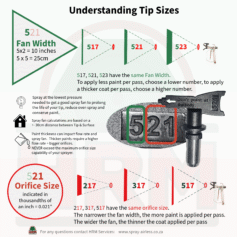
Understanding the numbers on your tip
xxxx
Tip Size Selection
Selecting the best tip size for the job ensures that you stay within your budget and get the finish you’re after.
Understanding tip size:
Tip sizes are measured in thousandths of an inch and are designed to produce optimum results at a 300mm distance from the work surface.
The number on the tip will tell you the spray fan, angle and orifice size.
Example: Tip 413
The first number: 413 refers to the angle of spray (i.e 40 degrees) and tells you the width of the spray in inches. To calculate the fan multiply the number with 2 (4 x 2 = 8inches)
The last two numbers 413 are denoting the orifice size, in this case 13 thou or .013″
The tip size matches the viscosity of the material and standard matches are:
Varnishes, Lacquers non pigmented 7-9 thous
Urethanes, Alkyd enamel gloss 9-11 thous
Acrylic/Urethanes Alkyd semi-gloss 11-13 thous
Waterbased Enamels, Acrylic, PU Coatings (airless grades) 13-15 thous
Alkyd Flat/UC Acrylic Roof and Exterior PVA’s 15 -19 thous
Acrylic Hi-Builds, Fibre Rich Waterproofing, Fire Retarders 19 -25 thous
Ceramic Coatings, Hi-Solids Epoxies 21-35 thous
The line filter size must match the tip size (this is a common fault – mismatched filters). Usually tips are quickly changed without downtimes and are reversible for self-cleaning.
Identifying a worn tip
Tip Wear:
Yes, airless tips do wear out! How fast the tip will wear depends on many factors, from how old the tip is to what type of material is sprayed though it, even the way the tip is cleaned can reduce its life expectancy.
To ensure you get the most out of your tips we recommend the following:
- Spray at the lowest pressure needed to get a good spray fan.
- Don’t use metal brushes to clean the tip, rather use a soft brush or some cloth.
- Strain gritty material with a strainer bag
- Clean your gun filters!
- Clean the tip and filters after every use.
How to identify a worn tip:
As the tip wears, the spray fan changes from a long tight line to a more oval shape. The fan will keep getting rounder and shorter till it looks like you are spraying a circle. This means that as the tip wears, the fan width reduces and you need to make more passes over the same area to get the desired coverage. The worse the wear, the more paint is used to cover the same area.
Spray Machine Selection
Selecting the spray machine that best suits your needs and budget can be challenging!
Below is some information to help, whether you’re doing research about airless, looking at investing in your first machine or considering adding to your fleet.
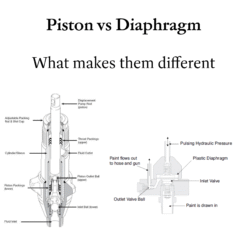
What makes them different?
Piston vs Diaphragm Pumps
There has been a recent debate about the types of paint sprayer pumps on the market, especially since this is the most important component of a sprayer. Contractors often refer to the entire unit as “the pump”. There are two general types of pumps offered for airless sprayers: diaphragm and piston. The following section describes the advantages and disadvantages of each type of pump for airless applications. All Graco airless sprayer use piston style pumps.
Advantage of Diaphragm Pumps
A diaphragm pump uses the sprayers motor to create highly pressurised oil to drive the pump’s diaphragm. During the stroke, the diaphragm moves down, and creates a vacuum within the paint chamber. The vacuum pulls the inlet valve open and the outlet valve is pushed closed by the spring and paint pressure in the hose. Paint is drawn into the paint chamber. On the up stroke, the inlet valve is closed and the outlet valve is forced open as paint is discharged to the sprayer hose.
- Tight pressure control when spraying at both low and high pressures
- High free-flow rates – good for a high volume transfer of fluids for texture applications and water
Usually cheaper at initial purchase
Advantage of Piston Pumps
A piston pump has many components including a piston, V packings, and check valves. The piston moves up creating a vacuum to suck up the paint into a ‘lower’ camber, while the upper chamber pushes the paint into a high-pressure hose. Then the piston moves down again, which re-fills the ‘upper’ chamber to pressurise the next up-stroke.
The V- packings create a seal to prevent pressure losses during the painting operation. Professional airless paint sprayers use self-adjusting V-packings to prevent premature wear and the need for repairs. Check valves, or ball and seat valves, direct the flow of painting material from the fluid section of the pump to the hose. This prevents the paint from being pumped back through the pick-up tube.
All piston pumps have these components in one form or another.
- Pumps higher viscosity coatings with ease
- Is able to produce higher pressures at common tip sizes
- Better atomization of paint – results in less spitting
- Ability to use longer hoses
- Able to withstand harder uses on the job – great for professional contractors
- Easy to repair
- Easy to prime – faster start-up
Runs only when needed – does not run constantly
The history of Airless Spray Machinery is not thoroughly documented, and each manufacturer has their own unique history. From our research we believe Graco, an established pump manufacturer, produced their first airless paint pump in 1957. This pump was a modified pneumatic piston paint transfer pump that had its pumping ratio increased to allow spraying through a nozzle.
This was the start in the USA. Graco had the capacity to grow rapidly and it is assumed that they became the leading manufacturer of airless piston pumps worldwide. Today you will find their pumps just about anywhere!
Across the ocean in Germany another company Wagner was already manufacturing hand held spray guns but had not yet made an airless machine. In 1964 they produced their first, an electric diaphragm airless. By 1970 they were the largest manufacturer of airless machinery in Europe.
Over the years these two companies have expanded and bought out numerous smaller manufacturers to emerge as the two largest groups in this field. The simplest way to see this is to look at how many cheaper copies of their equipment can be found in the market.
Materials-employed: The abrasive nature of paint causes extreme wear on parts inside the pump and this hard compound is essential to making them work. The process to manufacture of Tungsten Carbide was discovered in the early twentieth century but only became widely used in the 1940’s for weapon production, mining and manufacturing and so it follows that this was the perfect material for the job. To explain in simply – we have had numerous customers that have decided to have their own valves and seats machined for their sprayers (normally out of Stainless Steel), most often due to the unhappiness of the relatively high cost of these parts. And as we always expect- the unit operates for a short time and then it stops! Why? Well that stainless steel valve will have been ‘chewed’ away very rapidly by the high pressure paint and only the correct tungsten-carbide type works.
The other material that helped make airless machines possible is plastic, HDPE and PTFE – Poly-ethylene & Teflon. Solvent resistant and fairly wear resistant. Without these two materials the seals inside the pumps would not work. To explain this drop a rubber o-ring into solvent thinners or acetone and see what happens. Yes it swells drastically, inside a sprayer it would certainly fail. Teflon and Poly-ethylene were in mass production by the 1950’s. Teflon was first invented in 1938 & HDPE in 1933. Without the development of these materials today we may not have had the Spraying machines used today.
The future of Airless Spray is bright; the penetration of this equipment grows every year. These units are friendlier to the environment and more efficient than the older systems of spray. Year by year more painting companies are finding this technology as their solution to being more profitable
(AUTHOR: M GISI 2008)
Troubleshooting:
Below are some of the most common challenges our contractors face, and how to try and fix them on site.
Diaphragm Pump Operation
This guide is for Diaphragm pumps.
⏱️ Quick Overview
Best for: A very fast, general refresher before getting started.
My Tip keeps blocking!
Dirtly product.
Filter the paint, see youtube video how to use a filter bag.
Filter bags are re-usable, and available in a standard and elastic option.
YouTube Links:
Below is a summary of You Tube links to explore.
Diaphragm Pump Quick Setup
2 Minute summary on machine setup & operation
This video is suitable for someone who just needs a very fast, general refresh.
Diaphragm Pump Full Setup
How to set up your Diaphragm Airless Sprayer:
This video covers unboxing your unit, and how to assemble the various parts in the box (based on a Tecnover, but same principles apply for the DP6860e).
How to start/prime Diaphragm Airless Sprayer:
How to start / prime and operate your Diaphragm Airless Sprayer:
This is a quick introduction showing you how to prime the unit, and get ready to spray.
Manuals For your equipment
Find the relevant manuals and operating instructions for your pump or gun here.
Please note that this content is not created by HRM, but by the manufacturer of the product.
We aim to keep this section updated with models we’ve sold over the last half century.
This section is being updated, please check back or contact us for any specific brochures or information.